


A monthly progress report for parents fits on one page: what the student did, what went well, what to practise, next month’s goal, how to help at home and a three-sentence teacher’s comment. Here is a free template with 24 example comments.
In short
- A monthly progress report for parents fits on one page: what the student did, one thing that went well, one thing to practise, next month's goal, one way to help at home and the teacher's comment.
- Write the comment in three sentences: what you observed, the evidence for it, and what happens next month.
- Replace praise that fits any student ("works hard") with one piece of evidence a parent could see: a homework record, a recording or a piece of writing.
- In a month when scores fall, say so, name one likely cause and one thing you will change.
- The free template below (Excel / Google Sheets) includes the report, a filled example, 24 comment examples and a class log.
What goes in a monthly progress report for English learners?
A monthly progress report tells parents what their child did in English this month, what improved and what comes next, on one page. Parents cannot watch your lessons, so the report is often the only view they get of what happens in class.
Longer is not better. A parent should be able to read it in a minute and know what their child did this month and what they will do next. Six items are enough.
| Item | What to write | Example |
|---|---|---|
| This month | Units covered and homework handed in | Units 5–6, 11 of 12 homework tasks done |
| What went well | One change you noticed this month | Told us about her weekend in five past-tense sentences |
| What to practise | One thing to focus on next month | Answers questions with a single word |
| Next month's goal | Something the student will be able to do | Answer in two sentences, giving a reason |
| At home | One thing that takes five minutes | Listen to one homework recording together each week |
| Teacher's comment | Three sentences that tie it together | See the three-sentence formula below |
Completion and progress are different things. A completion rate shows that the student took part; what they said or wrote shows what they can do. "11 of 12 tasks done" on its own does not tell a parent whether their child improved, so put one thing that went well next to it.
One-page progress report template, with an example
A one-page report reads best in this order: who and when, what was covered, one line per skill, the comment, then the plan. The example below is filled in for a Grade 7 student. The name and details are invented.
Download the template: Excel / Google Sheets (editable). The file has the blank report, the filled example, the 24 comment examples and a log for a class of 30. A one-line note per student each week makes the comments quick to write at the end of the month.
| Item | Details |
|---|---|
| Student / class | Mia Lee / Grade 7, Tuesday and Thursday |
| Period | October 2026 (9 lessons) |
| Covered | Unit 5 My Weekend, Unit 6 At the Restaurant |
| Homework | 11 of 12 tasks done |
| Speaking | Says five or more past-tense sentences about her weekend. Still answers questions briefly. |
| Writing | Wrote a five-sentence diary. Fewer tense mistakes in each rewritten version. |
| Vocabulary | Used 34 of the 40 unit words in sentences. |
| Next month's goal | Answer a question in two sentences, giving a reason |
| At home | Once a week, listen to one homework recording with Mia. You do not need to correct anything. |
Teacher's comment: Mia began making past-tense sentences on her own this month. Her recording from the Unit 6 role-play shows it: she said six ordering sentences without stopping. Next month we will practise answering "Why?" with "because", in class and in homework.
How do you write a progress report comment? Three sentences
A progress report comment needs three sentences: an observation, the evidence and the next step. Kept in that order, a class of 30 takes two or three minutes per student, and a parent can tell at once whether the news is good or a concern.
The order follows the questions in Hattie and Timperley's well-known model of feedback: how is the learner doing, and where to next?
| Sentence | Its job | Example |
|---|---|---|
| 1. Observation | Name one thing that changed this month | Leo now finishes his sentences when he speaks. |
| 2. Evidence | Show the record behind it | In week 3 he linked four sentences in the speaking homework without a pause. |
| 3. Next step | Say what the student will practise and what you will do | Next month his homework will include making questions. |
Write about what the student did in all three. "Hard-working" and "enthusiastic" describe character: they are hard to support with evidence and do not lead to a next step.
24 progress report comments by skill and situation
The examples cover speaking, writing, vocabulary and homework habits, each for a student who is doing well, steady but stuck, or in need of support. Replace the units and numbers with your student's own record, and write nothing the record does not show.
Speaking
| Situation | Example 1 | Example 2 |
|---|---|---|
| Doing well | Completed all four role-play tasks this month. In the ordering task she answered the waiter's questions straight away. Next month we move on to giving reasons. | Added a sentence about his own experience to the five he had prepared. In the recording, the pauses between sentences are shorter than last month. Next month's goal is a one-minute talk. |
| Steady but stuck | Hands in every task, and most answers are one sentence. What she knows, she says accurately. Next month she will practise adding one more sentence to each answer. | His sentences are accurate, but he repeats the same patterns: many of this month's answers began with "I like". Next month's tasks will ask for three new expressions from the unit. |
| Needs support | Did two of the four speaking tasks, and finished the ones she started. Getting started seems to be the hard part. Next month we will say the first sentence together at the end of class and leave the rest for homework. | Takes time to understand the question, so his answers break off. When he heard it again slowly, he could answer. Next month he will listen to and repeat the question first. |
Writing
| Situation | Example 1 | Example 2 |
|---|---|---|
| Doing well | Wrote four five-sentence diaries, with fewer tense mistakes in each rewrite. In the last one she used "but" without being asked. Next month we move to eight sentences. | Corrects a sentence in the very next piece after feedback. The plural mistake from week 2 is gone by week 4. Next month he will practise splitting his writing into two paragraphs. |
| Steady but stuck | Hands in every piece, but the sentences stay the same length: mostly a subject and a verb. Next month each sentence will add when or where. | Good ideas, with the same spelling mistakes each time: "because" and "friend" three times this month. Next month she will practise her five most-missed words separately. |
| Needs support | Handed in one of four writing tasks. It was three sentences long and accurate. Next month we will write the first two sentences together in class and he will continue from there. | Writes a long version in her first language, then stops while translating. Next month she will restart with short tasks that change the words in a sentence frame she already knows. |
Vocabulary
| Situation | Example 1 | Example 2 |
|---|---|---|
| Doing well | Used 36 of the 40 unit words correctly in sentences, which is more than knowing what they mean. Next month she will make questions with them. | Got all ten words he missed last month right in this month's review. That comes from doing the review homework regularly, and we will keep the same routine. |
| Steady but stuck | Knows what the words mean, but gets about half of the sentence tasks right. Next month her vocabulary homework will focus on making sentences. | Learns new words quickly and forgets many by the review two weeks later. Next month he will have one extra five-minute review task each weekend. |
| Needs support | Completed half of this month's vocabulary tasks. The amount at one time seems to be too much. Next month the words will come five a day. | Finds it hard to connect sounds and spelling: she gets the listening choices right and the spelling wrong. Next month she will practise listening and copying first. |
Homework habits
| Situation | Example 1 | Example 2 |
|---|---|---|
| Doing well | Handed in all 12 tasks before the deadline, and went back to redo the questions she got wrong. Nothing to change. | Now does the homework on the day it is set, which is why he is first to answer in the five-minute review at the start of class. |
| Steady but stuck | Does every task, all at once just before the deadline. Speaking practice works better spread out, so next month I will suggest set days. | Hands everything in but rarely reads the feedback. Next month one task a week will be to correct a piece and hand it in again. |
| Needs support | Did 5 of 12 tasks this month; the two weeks he missed were school exam weeks. In the first week of next month we will restart with a lighter load. | Starts many tasks and stops partway. They seem to feel long to her. Next month the homework will come in pieces she can finish in five minutes. |
Which phrases should you avoid in a progress report?
Avoid praise without evidence, comments on character, comparison with other students, and worries without a plan. The question a parent most wants answered is "so what happens next month?"
| If you write | The problem | Write this |
|---|---|---|
| She is working hard. | It could be about any student. | She did 11 of 12 homework tasks and finished every speaking task. |
| He is passive in class. | It judges character and offers no way forward. | He answers when asked but does not speak first. Next month he will be the one who asks first in pair work. |
| She is near the top of the class. | It compares her with other children. | Her talk is 30 seconds longer than last month. |
| His grammar is weak. | It is too broad to act on. | He often drops "-ed" in the past tense. Next month we focus on that alone. |
| Please support her more at home. | It does not say what to do. | Once a week, listen to one homework recording together for five minutes. |
How do you write a report for a month when scores dropped?
Give the fact, one likely cause and one thing you will change, in that order. If you hold bad news back, the parent hears it for the first time at re-enrolment, and trust is hard to recover from there.
- The fact: "This month's writing scores were lower than last month's."
- A likely cause: "The new unit introduced a tense she had not met before, and two tasks were not handed in."
- What changes: "For the first two weeks she will write short sentences in the new tense, and in week 3 we return to five-sentence pieces."
Do not state the cause as certain. Write "it seems" and add a line asking what the parent has noticed at home, and the report becomes the start of a conversation.
What evidence should speaking and writing comments use?
Base speaking and writing comments on what the student said and wrote, not only on scores. Unlike a vocabulary quiz, they cannot be summed up as a number of right answers, so choose one record you could show.
- Speaking: whether the task was completed, how many sentences were linked, and what changed since last month's recording.
- Writing: the difference between the draft and the rewrite, whether a repeated mistake is fading, and sentence count and length.
- Both: if you use a rubric, which criterion moved. Our ESL speaking assessment rubric has an editable one.
You do not need to attach the recording or the writing. Name the record ("the week 3 homework recording") and listen to it together if the parent asks.
How long does it take for a class of 30?
Written all at once at the end of the month, reports take a long time; with one line a week, they are quick. For example, a class of 30 could run like this. The times are illustrations to adjust.
| When | What to do | Time (example) |
|---|---|---|
| After each week's lessons | One line in the class log for the 5–10 students who stood out | 10 minutes |
| Week 3 | Check which students have no notes and look at their homework record | 15 minutes |
| End of month | Write the three-sentence comment from the notes and the record | 2–3 minutes a student |
| End of month | Send the reports and book calls with parents who reply | 20 minutes |
Send it in the same week every month. A report that arrives only just before re-enrolment reads like a sales document.
How does this work in AvoLingo?
In AvoLingo, a monthly report for each student is drafted by AI from that student's homework and practice record. The teacher checks the draft, adds a comment and shares it with the parents. A draft is only a draft: nothing is sent before a teacher has read and edited it.
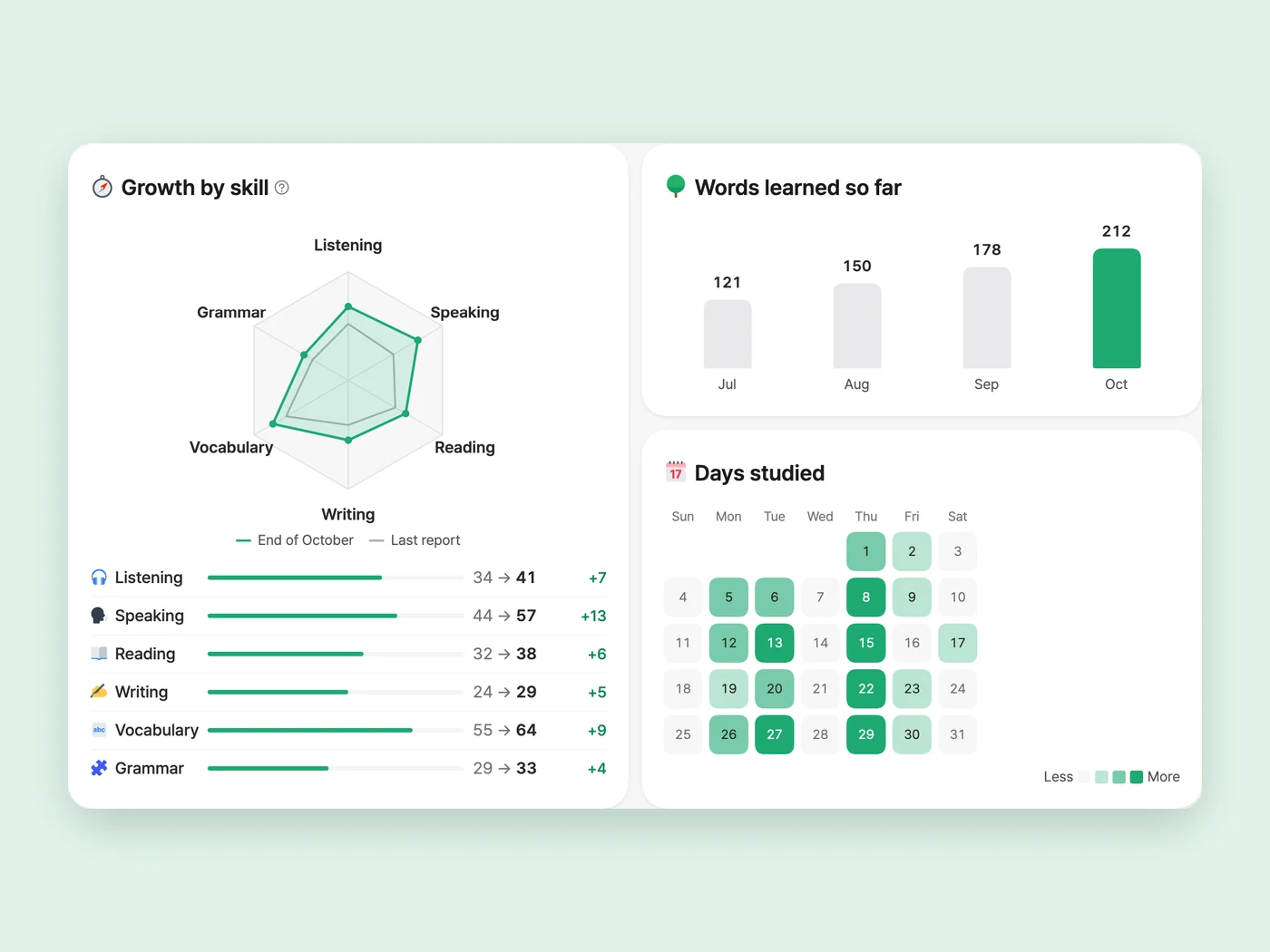
Here is the example student's report as it looks in AvoLingo. The screens are the real report; the school, the student and the numbers are invented. You can also open the sample report and scroll through it yourself.
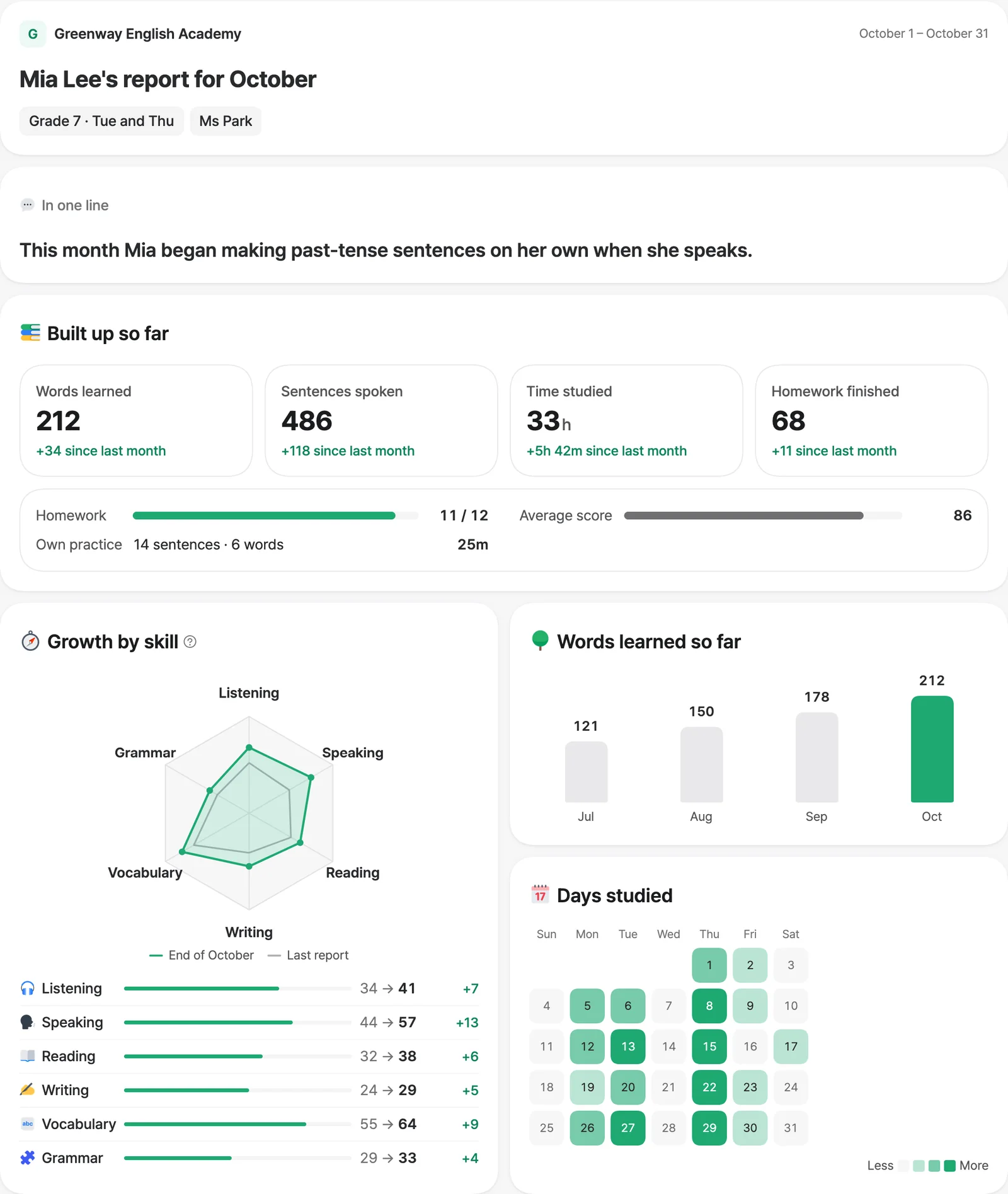
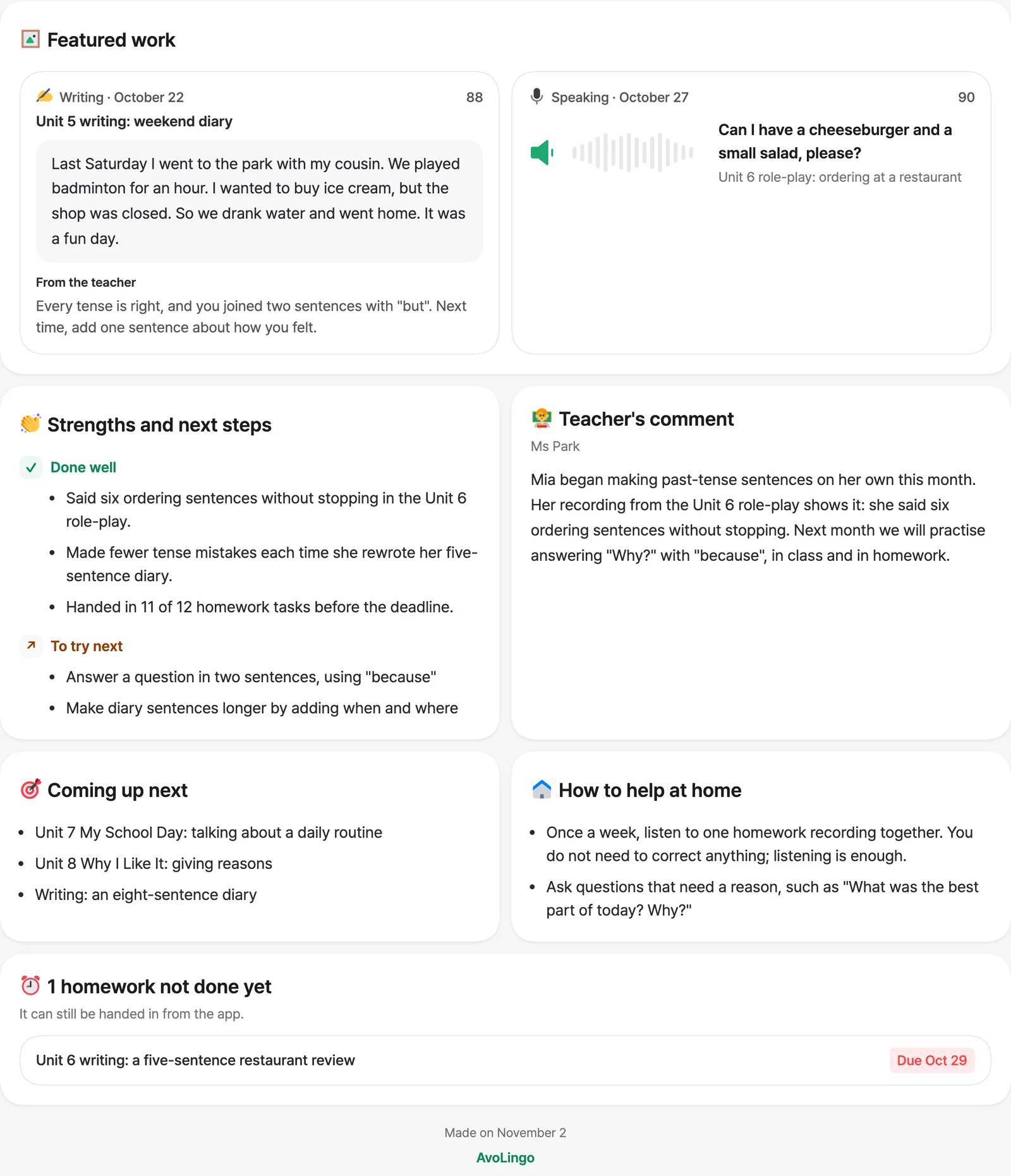
- The evidence is already collected. Speaking recordings and the drafts and rewrites of writing tasks are kept for each student, so you do not have to hunt for the second sentence of the comment.
- Each family gets its own link. The link to a student's report stops working on a set date.
- Parents can read it in their language. A report can be written in any of 12 languages.
- The record can be exported. The homework report downloads as Excel or CSV, ready to paste into the class log.
For how to set and review the homework itself, see our AI speaking homework guide. To see how it would work for your classes, read AvoLingo for schools and academies or request a demo.
FAQ
How often should you send progress reports to parents?
Monthly works for most language schools, on the same week and day each time. For example, the last Friday of the month gives parents something to expect and makes you start preparing in week 3. A week or two before school exams or a holiday is a better moment to talk about plans than just after exam results.
Can you send progress reports by email or a messaging app?
Yes, but send each student's results to that family only, never to a class group chat. Follow your school's policy and your country's data-protection rules, and get a parent's or guardian's consent for children where the law requires it. Tell families at enrolment what you will share and how.
What if parents do not seem to read the report?
Put the conclusion in the first line. "This month Mia began speaking in the past tense" gets through even if nothing else is read. One specific request under "At home" also brings more replies.
Do young learners need a different report?
Keep the same six items and use simpler sentences. Write what the child can now do ("can hear a colour word and point to it") in place of scores and counts, give one goal for next month, and choose something playful for home.
Is it acceptable to write report comments with AI?
For a first draft, yes, on two conditions: the draft is based on the student's actual record, and a teacher reads it against the facts and edits it before it goes out. Praise or concern that the record does not support cannot be explained in a parent meeting.
Sources
- Hattie and Timperley (2007), The power of feedback, Review of Educational Research 77(1)
- AvoLingo blog, AI speaking homework guide
- AvoLingo blog, ESL speaking assessment rubric
Written by the AvoLingo team. We used AI to help research and draft this article; sources are linked in the text.
Back to all articles