


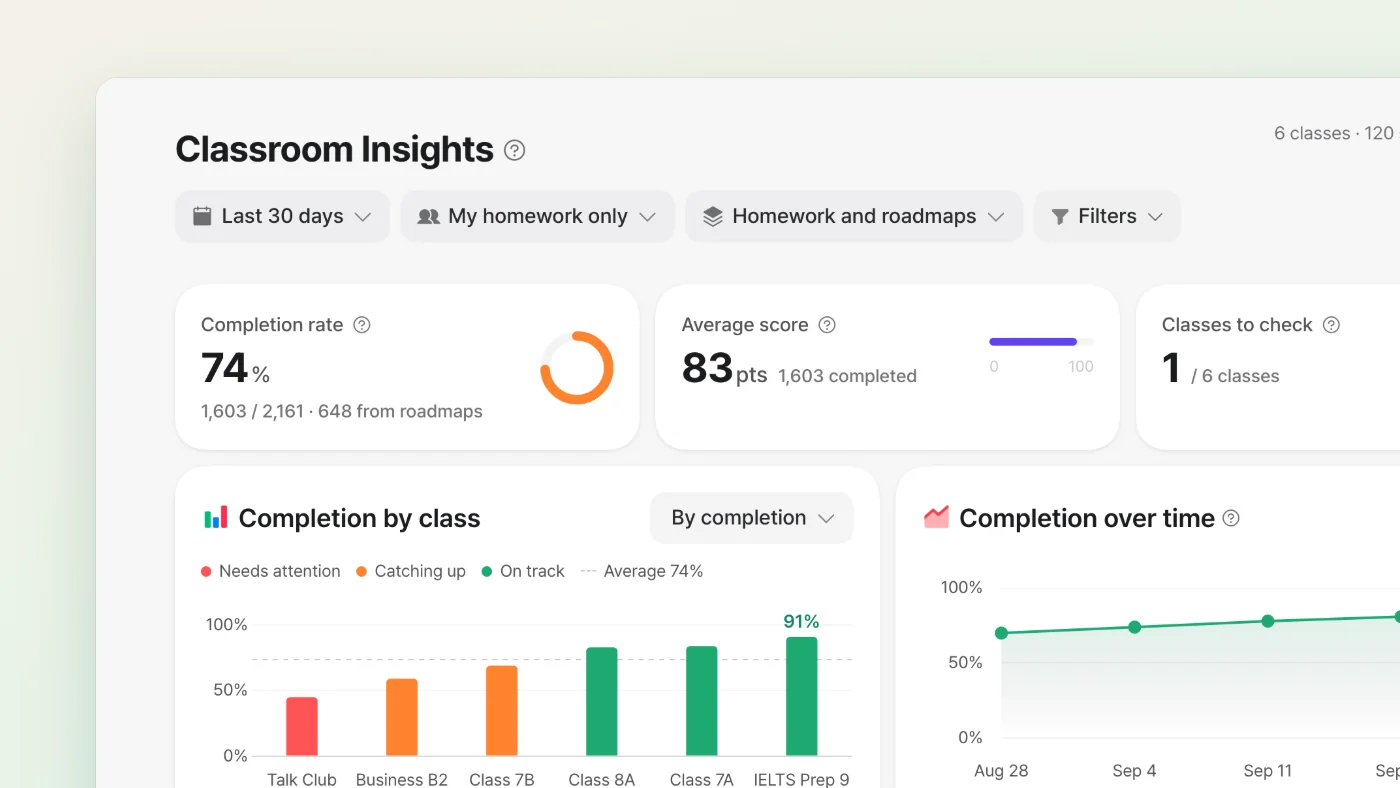
Language teachers and schools use AI mainly for the work around lessons: drafting homework from the coursebook, speaking practice at home, a first read of writing, and report drafts. The teacher still approves every task, gives the grade and writes the comment families read.
In short
- Language teachers and schools use AI mainly for the work around lessons: drafting homework from the coursebook, speaking practice at home, a first read of writing, vocabulary checks and report drafts.
- The teacher still chooses what is taught, approves each task before students see it, gives the grade and writes the comment a family reads.
- Before you choose a tool, ask every vendor the ten questions below, starting with "does it work from our own coursebook?"
- Start with one class and one task type for four weeks, and compare the AI's scores with your own before you rely on them.
How do language teachers and schools use AI?
Language teachers and schools use AI mainly for the work around lessons: preparing homework and materials, giving students practice between classes, a first read of writing and speaking, and drafting reports. Teaching the lesson, deciding grades and talking to families stay with the staff.
That matches what teachers report. The British Council surveyed 1,348 English language teachers in 118 countries and territories. They used AI tools for creating materials, helping students practise, planning lessons, correcting students' English, grading and administrative tasks; 24% used no AI tools at all.
Most advice on AI for ESL teachers is a list of tools. This article follows the week of a private language school or academy, where families or sponsors pay and expect to see progress, and students are in class for only a few hours a week.
AI in language teaching: eight weekly jobs, with and without AI
In most of a school's weekly jobs, AI can produce the first draft or the first read, and the teacher makes the decision. The table compares each job with and without AI; the notes under it add one risk to watch for each.
| Job | Without AI | With AI | Teacher still decides |
|---|---|---|---|
| Homework from the coursebook | Workbook pages, or a worksheet written the night before | Exercises drafted from the unit page in minutes | What is worth practising; reads every item before assigning it |
| Speaking practice outside class | Almost none, because it cannot be checked | Role-plays with an AI partner, with a record of attempts and scores | The situations, the number of attempts, what comes back into the lesson |
| Marking writing | A pile of scripts, returned a week later | A first read against your criteria in seconds | The criteria, the final score, the comment |
| Vocabulary checks | A paper quiz that uses lesson time | Quizzes from the unit's word list, marked automatically and repeated over weeks | Which words matter, and whether students can use them |
| Placement and level reports | A grammar test and a short interview | Adaptive tests, plus a term of practice scores as evidence | Which class a student joins and when they move up |
| Monthly reports | Thirty comments written from memory | A draft built from each student's record | What is true, what to stress, whether it is sent |
| Exam preparation | Past papers and one-to-one mock speaking tests | Repeated timed practice on exam tasks, with feedback each time | Strategy, each student's priorities, the forecast |
| Admin and retention | You learn a student has drifted when the family does not re-enrol | Weekly completion shows who has stopped | Who to call and what to say |
Setting homework from the coursebook
AI can draft exercises from the unit itself: from a PDF or a photo of the page it proposes vocabulary practice, comprehension questions, a writing prompt and a role-play on the unit's situation. Drafting takes minutes. Reading every item is still the teacher's job, and it takes time.
Watch for drafts that drift from the unit: words the class has not met, or an answer key with a mistake in it. Make it a rule that nothing is assigned unread.
Speaking practice outside class
Class time is the limit. For example, in a 60-minute lesson with 12 students, 20 minutes of pair work gives each student about 10 minutes of speaking, and the teacher hears little of it. With an AI partner, students can rehearse the unit's role-play at home as often as they like and get pronunciation scores on words and sentences.
A meta-analysis of 17 studies of conversation practice with dialogue systems found a medium effect on language proficiency (d = 0.58). A meta-analysis of 15 studies of pronunciation practice with speech recognition also found a medium effect overall (g = 0.69), but almost none when practice lasted four weeks or less, and only a small one when students practised alone. So bring the task back into the lesson as pair work; our guide to AI speaking homework describes the routine.
Watch for the novelty wearing off after a few weeks, and recognition errors that get marked as the student's mistakes. Listen to a few recordings yourself each week.
Marking writing
By the time a marked script comes back, the student has often forgotten writing it. AI can give a first read within seconds: a score for each criterion and the reason for it. The student revises while the task is fresh, and the teacher reads the second draft.
A 2023 meta-analysis of 20 studies found a medium effect of automated feedback on students' writing (g = 0.55), with results that varied widely between studies. In a six-week study of 48 university learners of English, learning outcomes were no different for students who got feedback from ChatGPT (GPT-4) and students who got it from their tutor.
Watch for confident scores that are wrong, and homework the student did not write. Mark a sample yourself and compare, and keep some writing in class, by hand.
Vocabulary checks
Software has done this job for years: quizzes built from the unit's word list, marked automatically and brought back at intervals. The intervals matter. A meta-analysis of 48 experiments found a medium-to-large effect of spaced practice on second language learning, and longer gaps did better than shorter ones on delayed tests.
Watch for quiz scores that look better than the student's speaking. Recognising a word is easier than using it, so check that the words turn up in students' own sentences.
Placement and level reports
Adaptive online tests can do the grammar-test part of placement; Cambridge, for example, describes its Linguaskill test as using AI and computer-adaptive technology. For level reports, a term of practice scores by task and by criterion gives more evidence than one test day. The placement itself stays with staff, because age, confidence and the timetable count as well as a score.
Watch for practice scores printed as levels. Homework results cannot certify "B1"; our speaking assessment rubric explains why one classroom task is not a level.
Report card comments and monthly reports
Thirty comments written in one evening, from memory, come out alike. AI can draft each report from the student's own record: tasks completed, scores by skill, a sentence the student wrote or said. The teacher checks the draft against the student they know and adds the personal comment. Our progress report template has a three-sentence pattern for it.
Watch for fluent sentences the record does not support. If you could not explain a line in a parent meeting, delete it.
Exam preparation periods
Before exams, marking peaks and one-to-one mock speaking tests use up teacher hours. Exam tasks have fixed formats, so students can repeat timed speaking and writing tasks with an AI and get feedback each time. Still run at least one mock under real conditions, marked by a teacher.
Watch for predicted bands. A tool's "6.5" is an estimate from practice. No examiner gave it, and families should be told so.
Admin and retention: showing families progress
Weekly completion shows who did the homework and who stopped two weeks ago, long before a family decides not to re-enrol. Someone at the school still has to make the phone call.
Completion also went together with progress in AvoLingo's one published result, which comes from a university prep school and not from an academy. At Bahçeşehir University's English prep school, 98% of module results (268 of 274) went up a level when students did 75% or more of their AvoLingo homework; with none, 42% did. The data is observational, so it cannot show that one caused the other.
Watch for the number becoming the goal. Students who are chased for completion click through tasks. And a progress report that arrives only before re-enrolment reads like a sales letter.
How to choose AI tools for language teachers: ten questions for vendors
Test whether the tool fits the routine your teachers already have. Bring one of your own coursebook units to the demo, and ask every vendor the same ten questions.
- Does it work from our own coursebook? Ask the vendor to build a task from the unit you brought, while you watch. Check your coursebook licence too: some publishers limit copying pages into other tools, so ask the publisher or your distributor if you are unsure.
- Does a teacher approve everything before students see it? Tasks, feedback wording and reports.
- Can we set the marking criteria and change a score? Criteria and weights should match your rubric, and a teacher's score should replace the AI's.
- What do the reports show? Look for completion and scores by student, by task and by criterion, an export, and a view for parents.
- Where does student data go? Ask what is recorded (voice, writing, scores), where and for how long, whether it trains AI models, and how it is deleted.
- How is consent handled for children? Rules differ by country. The US COPPA Rule covers online services for children under 13. In the EU, the age threshold for parental consent varies between 13 and 16 by member state. UNESCO's guidance sets an age limit of 13 for AI tools in the classroom.
- Which devices does it run on? Students' phones, a shared family tablet, the school's computers. Ask what happens with a weak connection or a noisy room.
- How long until the first task is assigned? Ask who sets up classes and accounts, and how much training teachers need.
- Is there a free trial or a pilot without a contract? Four weeks with one class tells you more than a demo.
- Which languages? Check the languages you teach, the language of instructions for beginners, and the language parents read.
How to use AI in language teaching: a four-week pilot
Start with one class, one willing teacher and one task type, and run it for four weeks before deciding anything else. Tell families first what the tool is, what it records, and that the teacher sets the grade.
| Week | What happens | What to check |
|---|---|---|
| Before | Choose the class and one task type, for example a weekly role-play from the unit. Send families a short note and collect consent where the law requires it. Note the current homework completion rate. | Every student has a device they can use at home |
| 1 | Students do the first task in class, on their own devices, so login and microphone problems appear while the teacher is in the room. | Who could not get in, and why |
| 2 | The same task type goes home. The teacher reviews the results before the next lesson and brings two common errors into class. | Completion, and how long the review took |
| 3 | Repeat, and ask for a second attempt after feedback. The teacher scores five students' work without looking at the AI's scores, then compares. | Where teacher and AI disagree |
| 4 | Ask students what helped. Compare completion and teacher time with the start. | Stop, continue, or add a second class |
Four weeks is enough to show whether the routine works. It is too short to show learning gains: in the pronunciation meta-analysis above, one to four weeks of practice had almost no effect, and five weeks or more had a clear one. Add a second task type only when the first has become routine.
What does AI do badly in language teaching?
AI is weak at intonation and at real interaction, less accurate with some voices, and hard for young children to use alone. It also cannot stand in for the teacher's comment when a family asks how their child is doing.
- Intonation and stress. In the pronunciation meta-analysis, the effect on individual sounds was large (g = 0.82) and the effect on stress and intonation was small (g = 0.37). Teach those in class.
- Interaction. An AI partner waits for its turn and never talks over anyone. Taking turns in a group, interrupting politely and repairing a misunderstanding need other people, so assess interaction in class.
- Some voices. A 2020 study of five commercial speech-recognition systems found an average word error rate of 0.35 for Black speakers and 0.19 for white speakers in US interviews. A 2025 preprint reports that current speech models still make more errors on children's speech than on adults'. Both are reasons not to grade on a recognition score alone.
- Young learners. The pronunciation meta-analysis found a larger effect for adults than for learners under 18. With children, keep tasks to a few minutes, do the first ones in class, and check the age rules in question 6.
- Trust. In the ChatGPT feedback study above, a second group of 43 students who received both kinds of feedback split almost evenly on which they preferred. In a fee-paying school, the teacher's comment is what shows a parent that someone knows their child, so keep the teacher writing it.
How does AvoLingo fit?
AvoLingo is an AI language-learning service by AvoLabs: a learner app for iOS, Android and the web, and a teacher dashboard. Teachers make speaking, writing, vocabulary, reading and listening homework from their own materials (a unit PDF, a photo of a coursebook page, a typed topic or a YouTube link), then edit and preview it. Students receive it only after the teacher assigns it.
Students practise conversations and role-plays with an AI tutor and get pronunciation scores on words and sentences. Writing is scored by criterion with an explanation; teachers set the criteria and weights and can change any score. Teachers see each student's completion and scores by task and by criterion, and each monthly parent report is drafted for the teacher to check, edit and send. Homework can also be created and assigned from Claude or ChatGPT through the AvoLingo connector.
There are 13 languages to learn. Teachers can start free, and schools and academies can run a free pilot with no contract. See AvoLingo for schools and academies and the pricing page.
FAQ
Will AI replace language teachers?
Nothing in how schools use these tools points that way. AI handles practice, first-read feedback and drafts; teachers plan the course, teach, judge progress and talk to families. In the British Council's research, most of the experts interviewed thought AI would not replace the need for human teachers any time soon, and perhaps never.
Are free AI tools for ESL teachers enough for a school?
For one teacher's preparation, often yes. A general chatbot such as ChatGPT or Claude can draft texts, exercises and lesson plans, and many teachers start there. A school needs more once homework is assigned and tracked: class lists, tasks that reach students, a record of each student's work, and consent for children.
Can AI mark essays accurately?
The research cited here does not settle it, so treat an AI score as a proposal. Those studies measured whether students' writing improved after automated feedback; they did not test whether an AI score matches a teacher's. Let the AI comment and suggest a score, and have a teacher confirm any score that counts.
Can AI write report card comments?
It can draft them when it works from the student's record: tasks completed, scores by skill, a sentence the student wrote or said. Without a record, a draft can only be generic. The teacher checks each line against the student they know and writes the personal comment.
Is AI speaking practice suitable for children?
With care. Speech recognition makes more errors on children's voices, and UNESCO's guidance sets an age limit of 13 for AI tools in the classroom. For younger children, keep tasks short, do them in class or with a parent nearby, and get the consent your country requires.
How much time does AI save teachers in a language school?
We found no reliable published figure for language schools, and it depends on what you did before. Drafting homework and reports gets faster. Speaking homework is different: if you set none before, reviewing it is new work, about 15 minutes a task in the routine in our speaking homework guide. Measure it in your own pilot.
Sources
- British Council, Artificial intelligence and English language teaching: preparing for the future
- Bibauw, Van den Noortgate, François and Desmet (2022), Dialogue systems for language learning: a meta-analysis, Language Learning & Technology 26(1)
- Ngo, Chen and Lai (2024), The effectiveness of automatic speech recognition in ESL/EFL pronunciation: a meta-analysis, ReCALL 36(1)
- Fleckenstein, Liebenow and Meyer (2023), Automated feedback and writing: a multi-level meta-analysis of effects on students' performance, Frontiers in Artificial Intelligence 6
- Escalante, Pack and Barrett (2023), AI-generated feedback on writing: insights into efficacy and ENL student preference, International Journal of Educational Technology in Higher Education 20, article 57
- Kim and Webb (2022), The effects of spaced practice on second language learning: a meta-analysis, Language Learning 72(1)
- Koenecke et al. (2020), Racial disparities in automated speech recognition, PNAS 117(14)
- Singh, Sahidullah and Kinnunen (2025), Causal analysis of ASR errors for children (preprint), arXiv:2502.08587
- Cambridge English, Linguaskill
- US Federal Trade Commission, Children's Online Privacy Protection Rule (COPPA)
- European Commission, Are there any specific safeguards for data about children?
- UNESCO (2023), Governments must quickly regulate generative AI in schools (press release, 7 September 2023)
- AvoLingo (2026), Does AI speaking homework work? Results from 1,033 students
Written by the AvoLingo team. We used AI to help research and draft this article; sources are linked in the text.
Back to all articles