


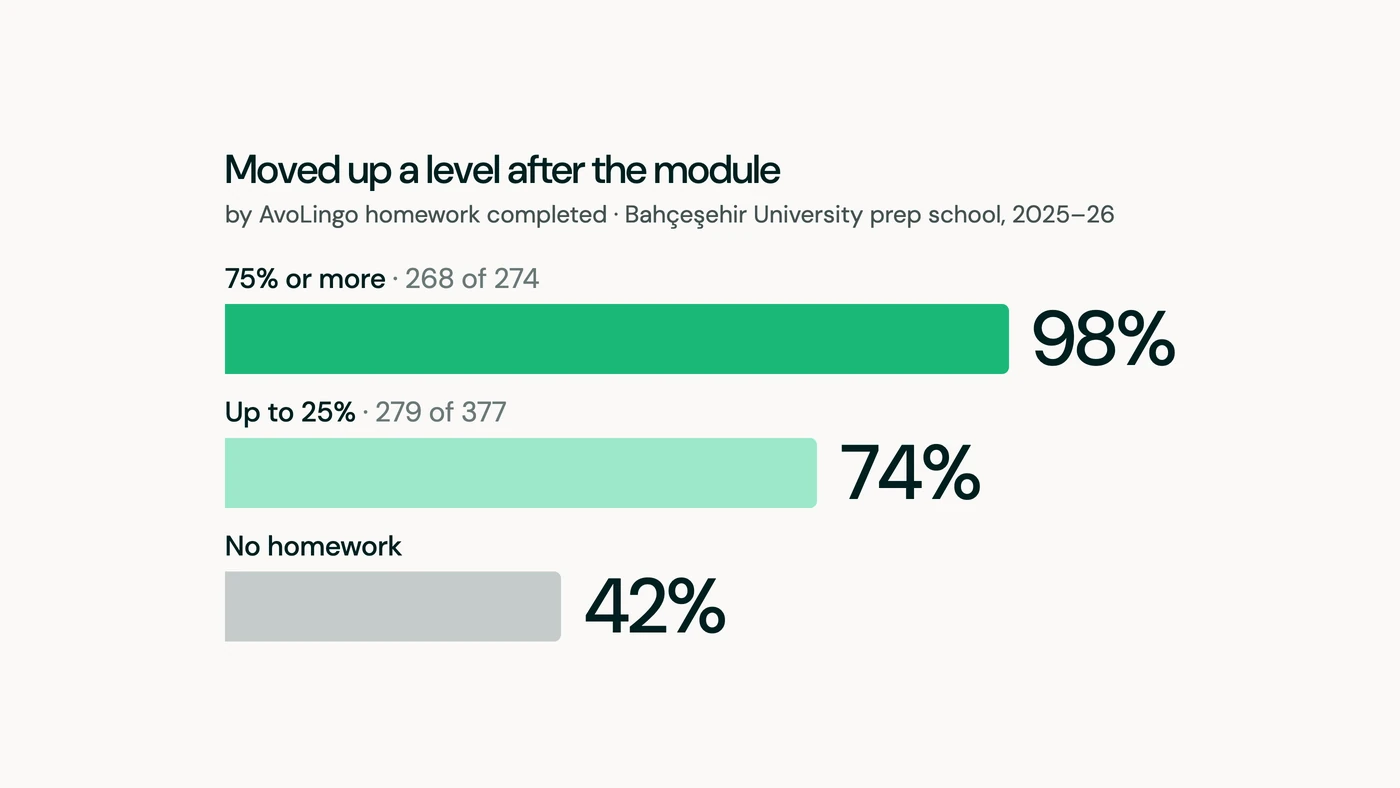
At Bahçeşehir University's English prep school, students who completed 75% or more of their AI speaking homework moved up a level 98% of the time, against 42% with none. Here is what the data shows and what it cannot.
In short
- At Bahçeşehir University's English prep school in 2025–26, students who completed 75% or more of their AvoLingo homework in a module moved up a level in 98% of cases (268 of 274).
- Where students completed up to 25%, 74% moved up (279 of 377). With no homework in the module, 42% did.
- The school decided who moved up; AvoLingo scores were not used. The data covers 1,033 students across one academic year.
- This is observational data from one school, not a controlled trial. It shows that homework completion and progress went together, not that one caused the other.
Does AI speaking homework work?
In this data, yes, with a caveat. Students who did most of their AI speaking homework moved up a level far more often than students who did none: 98% against 42%. That is a strong association in one university prep school over one year. It is not proof that the homework caused the progress, and this article sets out why.
The figures come from AvoLingo platform data for Bahçeşehir University (BAU) English Preparatory School in Türkiye, matched with the school's own decision at the end of each module.
| AvoLingo homework completed in the module | Moved up a level | Count |
|---|---|---|
| 75% or more | 98% | 268 of 274 |
| Up to 25% | 74% | 279 of 377 |
| No homework | 42% | Count not in our summary |
Each count is a module result, not a person: one student's outcome at the end of one eight-week module. A student who studied all year appears more than once.
Our analysis summary reports the two ends of the range. For the middle it gives one figure: students who completed more than half of their homework moved up at a rate of 88% or more at every level.
Source: AvoLingo platform data, Bahçeşehir University English Preparatory School, October 2025 to May 2026.
What was measured, and how?
We compared how much of their AvoLingo homework students completed in a module with whether the school moved them up afterwards. The definitions matter, so here they are in full.
- Who: 1,033 students in the English Preparatory School, from A1 to the proficiency track.
- When: the 2025–26 academic year, which ran as four eight-week modules from October to May.
- The homework: the school assigned AvoLingo practice every week, matched to each class level. It combined AI speaking (conversations with an AI tutor), pronunciation, grammar and vocabulary. "Speaking homework" here means that weekly set, not conversation alone.
- Homework completed: the share of a student's AvoLingo homework for a module that they completed. The bands are no homework, up to 25%, and 75% or more.
- Moved up a level: after each eight-week module, the school decides whether a student goes on to the next level or repeats. This was the school's own placement decision. AvoLingo scores were not used.
- Unit of analysis: the module-to-module move. The analysis covers 1,719 moves by students who did at least one task.
What does the data not show?
It does not show that homework caused the progress. Four limits apply.
- No control group. Nobody was assigned to do or skip homework. Students chose, and we observed.
- Motivated students do both. A student who finishes their homework probably also attends class, revises and asks questions. Part of the gap between 98% and 42% reflects the student, not the task.
- One school, one year. BAU's programme, staff and students are not every programme's. The pattern may be weaker or stronger elsewhere.
- The outcome is level progression, not a speaking test. We do not have a separate speaking score for these students, so we cannot say how much of the progress was in speaking.
Research on homework in general has the same weakness. A synthesis of homework studies from 1987 to 2003 by Cooper, Robinson and Patall found generally consistent evidence that homework has a positive influence on achievement, and also that every study, whatever its type, had design flaws.
Three checks inside the data
The obvious objection is that the best students simply did more homework. Three comparisons go some way to answering it.
- The same student, two outcomes. 162 students moved up after some modules and repeated others. Their homework completion was 47% in the modules before they moved up and 33% in the modules before they repeated. Comparing students with themselves rules out fixed differences such as ability.
- Second chances. Among students who had repeated a module, 88% of those who then completed half or more of their homework moved up in the following module, against 47% of those who completed under half.
- Earlier results taken into account. Allowing for earlier homework and earlier results, each extra 10 points of completion was still linked to about 1.3 times the odds of moving up.
These checks reduce the concern; they do not remove it. A student can have a hard module for reasons we cannot see, and both do less homework and do worse in class.
What did the school do in practice?
BAU made the practice a weekly routine set by the school, not an optional extra for students to find. Three points stand out.
- Weekly, and matched to level. Each class received practice for its own level every week, rather than one bank of activities for everyone.
- Take-up was uneven. 79% of students completed at least one homework task during the year, and 343 students completed 50 tasks or more. Some students did none, which is why the "no homework" group exists.
- The school extended it. BAU started with 700 students in September 2025. As of September 2026 it holds 2,000 student licences and 300 for academic staff.
We do not have a lesson-by-lesson record of how individual instructors changed their teaching, so we make no claim about that.
How much was the platform used?
Across the year, the 1,033 students completed 36,212 homework tasks, including 25,887 AI conversations.
| Measure, October 2025 to May 2026 | Total |
|---|---|
| Students | 1,033 |
| Homework tasks completed | 36,212 |
| AI conversations completed | 25,887 |
| Messages students wrote to the AI | 544,725 |
| Words pronounced and scored | 164,865 |
Do scores improve after AI feedback?
On the same task, yes. When students tried again after AI feedback, average scores rose on both task types we looked at.
| Task | First try | After feedback |
|---|---|---|
| Quiz | 40 | 84 |
| Chat | 49 | 70 |
Scores are averages out of 100 on the same task. This shows that students used the feedback straight away. It does not show how much they retained a month later, and students who choose to retry may differ from those who do not.
The wider research points the same way. Hattie and Timperley's review of feedback research describes feedback as one of the most powerful influences on learning, with effects that depend on the type of feedback and how it is given. A meta-analysis of 17 studies by Bibauw and colleagues found that conversation practice with dialogue systems had a medium effect on second-language proficiency (d = 0.58). Those studies were designed to test effectiveness, which our usage data was not.
What should prep-school directors and coordinators take from this?
- Track completion per module, not log-ins. Completion was the measure that separated outcomes here. Ask any supplier for it by student and by section.
- Find the no-homework group early. Students with no homework in a module moved up 42% of the time. They are the ones to contact in the first weeks, not at the end.
- Set practice weekly and tie it to the level. That is how BAU ran it. Practice built from your own syllabus is easier to require; see our guide to ESP course design for one way to plan it.
- Build in a second attempt. Scores rose when students retried after feedback, so give credit for the retry and not only the first try.
- Keep placement with your staff. At BAU the school decided who moved up. AI practice works alongside teachers; it gives them more evidence and does not replace their judgement.
If you run a pilot, plan a comparison from the start, for example between sections, so that you can say more than we can here. AvoLingo for universities shows how courses and assignments are set up, and you can tell us about your programme to arrange a demo.
FAQ
Is this a controlled study?
No. It is observational data from one school year: 1,033 students at one university, with no control group and no random assignment. It shows an association between homework completion and moving up a level, not proof of causation.
How much homework is enough?
The data does not give a threshold. Students who completed 75% or more moved up 98% of the time, and those who completed more than half moved up at 88% or more at every level. Each extra 10 points of completion went with better odds, so more was better across the range.
Did AvoLingo scores decide who moved up?
No. Moving up was the school's own placement decision after each eight-week module, made independently of AvoLingo scores.
Does this apply to K-12?
We do not know. These are university prep students in an intensive English programme. Younger learners, fewer weekly hours and different assessments could all change the picture, and we have not published K-12 results.
Does it prove that speaking improved?
Not on its own. The outcome is level progression decided by the school. The before-and-after scores show improvement on the same task after feedback, which is a narrower claim.
Sources
- AvoLingo platform data, Bahçeşehir University English Preparatory School, October 2025 to May 2026 (1,033 students). Level decisions were made by the school.
- Cooper, Robinson and Patall (2006), Does homework improve academic achievement? A synthesis of research, 1987–2003, Review of Educational Research 76(1)
- Hattie and Timperley (2007), The power of feedback, Review of Educational Research 77(1)
- Bibauw, Van den Noortgate, François and Desmet (2022), Dialogue systems for language learning: a meta-analysis, Language Learning & Technology 26(1)
Written by the AvoLingo team. We used AI to help research and draft this article; sources are linked in the text.
Back to all articles